Julia Boutros at 58: Four Decades of a Voice That Never Compromised
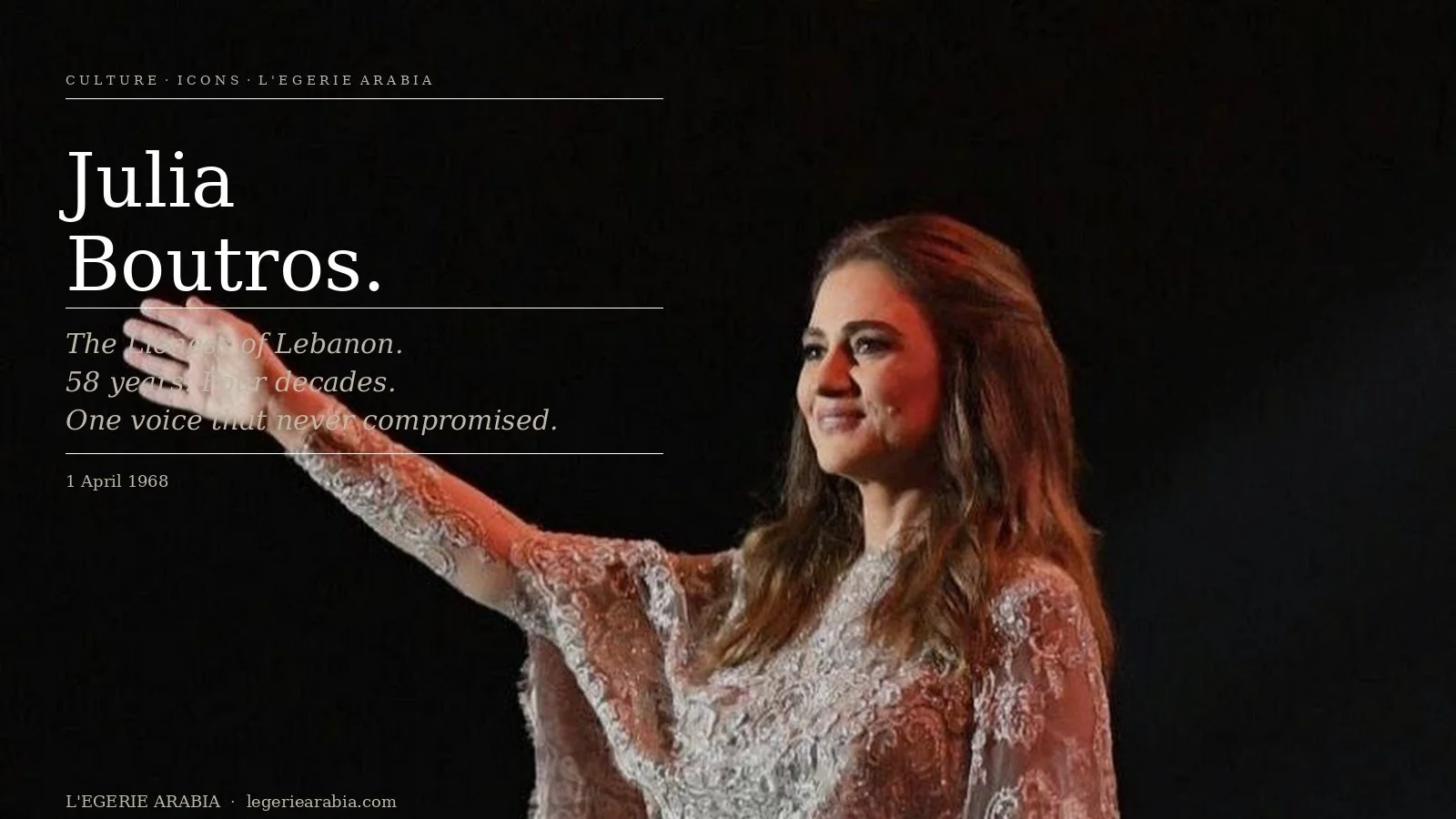
There are artists who have careers. And there are artists who have convictions. Julia Boutros, who turned 58 on the first of April, belongs entirely to the second category.
Over four decades, she has released albums that became anthems, performed on stages that became historic, and occupied a place in the Arab cultural imagination that no trend, no generation shift, and no changing musical landscape has managed to displace. She did not become an icon by chasing one. She became one by refusing to be anything else.
The Beginning
Julia Boutros recorded her first song at twelve years old, introduced to Elias Rahbani's studio by her music teacher. The three French-language songs she recorded in those early years gave no particular indication of what was coming. What came, in the 1980s, was something the Arab world was not entirely prepared for.
With Ghabet Shams El Haq The Sun of Justice Has Gone Boutros announced herself not as a pop singer but as a voice with a position. She was seventeen years old. The song, written by her brother Ziad, combined traditional Arabic melodic structures with a directness of statement that was unusual for a young female artist at the time. It became a hit not because it was fashionable but because it was true.
The Voice as Political Act
What distinguished Boutros from her contemporaries was never primarily her vocal range, although that is exceptional. It was her understanding that a song can be an act.
Her music, across more than ten albums, consistently engaged with the political realities of Lebanon, Palestine, and the broader Arab world. She did not approach these subjects with caution or with the careful neutrality that protects careers. She approached them with the same conviction she brought to every performance — full voice, full presence, full commitment.
In October 2006, she released Ahibaii Dearly Beloved a song whose lyrics were drawn from a letter written by Hassan Nasrallah to fighters in South Lebanon during the summer war with Israel. The proceeds, eventually totalling three million dollars, went to the families of Lebanese soldiers, civilians, and Hezbollah fighters who had died in the conflict. The song was not without controversy. Nothing worth doing is. It became one of the most discussed Arabic songs of the decade.
In 2023, during the war in Gaza, she released Yamma Mwel Lhawa in solidarity with Palestinians. She has never stopped. That is the defining characteristic of a conviction rather than a career: it does not pause between albums.
The Lioness of Lebanon
The title she carries Lioness of Lebanon was not given by a magazine or a marketing campaign. It was conferred, organically and collectively, by the audiences who recognised in her voice something that their own lives required: the refusal to be silent about what matters.
Her fan base spans multiple generations and extends well beyond Lebanon. In the Gulf, in Syria, in Palestine, across the Arab diaspora Boutros has been a consistent presence not because she toured aggressively or managed her brand carefully but because her music addressed experiences that are shared, losses that are collective, and a will to endure that transcends any single national identity.
She is married to Elias Bou Saab, a former Lebanese Defence Minister and current Deputy Speaker of Parliament. She has spoken publicly about the complexity of occupying that position as an artist whose work is explicitly political, married to a politician. She has never suggested this complexity required her to be less of what she is.
The Style of Sovereignty
To discuss Julia Boutros without discussing her presence on stage would be to miss something essential. She has always understood that the visual dimension of a performance is not decoration. It is argument.
The red kaftan with its column of gold jewellery. The white lace dress with its dramatic sleeves. The emerald sequined gown at a private gathering. Each look carries the same quality as her music: it does not ask for permission. It does not understate. It presents itself fully and trusts the audience to receive it.
This is the sovereign aesthetic in its purest form not ostentation, but conviction. The difference matters enormously.
Four Decades
At 58, Julia Boutros has outlasted trends, political cycles, and the attention spans of a media industry that is permanently in search of the next thing. She has done this by understanding something that most artists learn too late, if they learn it at all: that longevity in culture is not achieved by remaining relevant. It is achieved by remaining true.
The Arab world has always known this about her. L'ÉGÉRIE ARABIA simply takes the occasion of her birthday to say it clearly.
Happy birthday to the Lioness of Lebanon. Four decades. One voice. A career that became a movement.
L'ÉGÉRIE ARABIA — fashion intelligence and cultural celebration for the sovereign woman of the Gulf. legeriearabia.com